
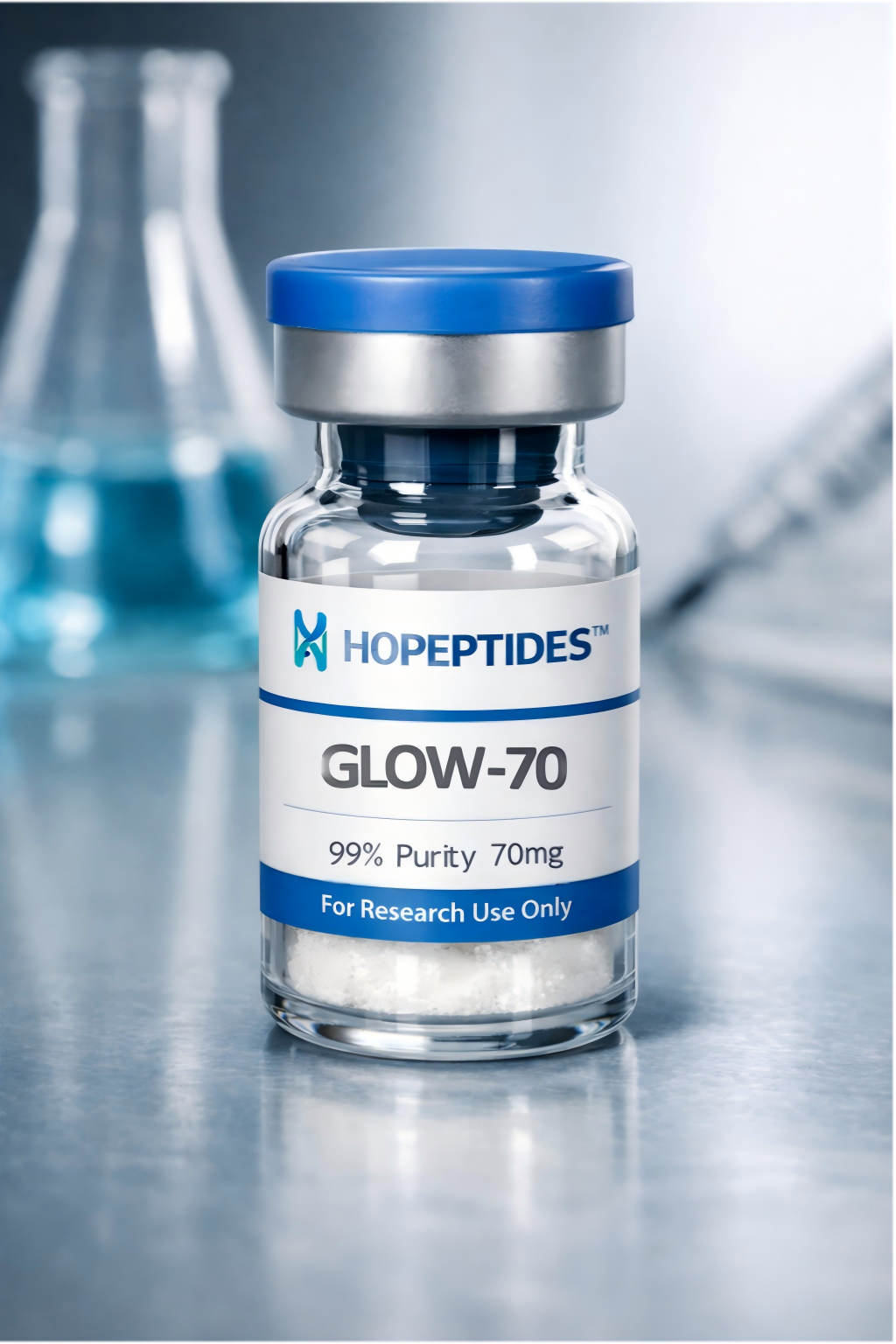
Glow 70 mg — Research Peptide Blend (Technical Information)
1. Product Overview
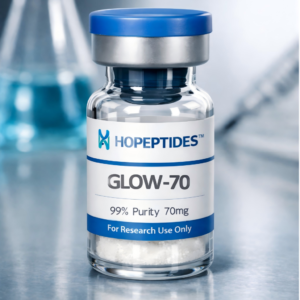
Glow 70 mg is a synergistic research peptide blend combining three well‑characterized peptides in a single vial, designed to support advanced scientific research into cellular repair, tissue regeneration, and extracellular matrix biology. Each component in the blend has a distinct molecular profile and research pedigree, allowing laboratories to investigate multi‑pathway peptide interactions in regenerative, inflammation‑modulation, and structural biology models.
-
Product Name: Glow 70 mg
-
Format: Lyophilized peptide powder
-
Total Peptide Content: 70 mg per vial (combined)
-
Blend Composition: GHK‑Cu (50 mg), BPC‑157 (10 mg), TB‑500 (10 mg)
-
Intended Use: For in vitro and controlled laboratory research only (RUO). Not for human or veterinary use.
2. Physical & Chemical Specifications
| Property | Specification |
|---|---|
| Form | White to off‑white lyophilized powder |
| Total Peptide Content | 70 mg per vial |
| Component Breakdown | GHK‑Cu 50 mg; BPC‑157 10 mg; TB‑500 10 mg |
| Purity | ≥ 98–99 % (HPLC verified) |
| Molecular Profiles | Varies by peptide; copper‑binding tripeptide, gastric peptide fragment, thymosin β‑4 fragment |
| Solubility | Soluble in sterile water or appropriate laboratory buffers |
| Storage (Lyophilized) | –20 °C, dry, protected from light and moisture |
| Storage (Reconstituted) | 2–8 °C short‑term; aliquot and freeze at –20 °C for extended stability |
| Stability | High when stored in sealed, sterile conditions |
3. Composition & Peptide Characteristics
GHK‑Cu (Copper Peptide) — ~50 mg
-
A naturally occurring glycyl‑L‑histidyl‑L‑lysine–copper complex used in research for its capacity to modulate gene expression, promote collagen synthesis, and explore oxidative‑stress pathways.
BPC‑157 (Body Protection Compound‑157) — ~10 mg
-
A stable synthetic peptide derived from a gastric protein sequence; extensively applied in in vitro studies relating to tendon/ligament repair, angiogenesis, and soft‑tissue integrity.
TB‑500 (Thymosin β‑4 Fragment) — ~10 mg
-
A peptide fragment from thymosin β‑4 studied for cell migration, angiogenic processes, and regenerative signaling in tissue cultures.
4. Mechanisms & Research Context
Although not approved as therapeutics, each component in the Glow blend contributes distinct biological activities that are valuable in scientific research:
-
GHK‑Cu: Studied for its effects on extracellular matrix regulation, collagen/elastin synthesis pathways, and antioxidant responses.
-
BPC‑157: Investigated in tissue modeling for fibroblast proliferation, nitric‑oxide signaling, and microvascular repair.
-
TB‑500: Explored in research involving cytoskeletal remodeling, angiogenic signals, and progenitor cell recruitment in healing models.
Synergistic Research Value: By formulating these peptides together, Glow enables studies of peptide–peptide interactions, combined signaling pathway effects, and multi‑axis regenerative responses within controlled laboratory environments.
5. Reconstitution & Handling (Research Protocols)
Typical Reconstitution Approach (Laboratory):
-
Aseptically add sterile water or bacteriostatic water to the vial to achieve a defined concentration suitable for specific experimental assays.
-
Gently swirl to dissolve without vigorous agitation to preserve peptide integrity.
-
Label with reconstitution details and concentration.
-
Use reconstituted solution promptly; maintain at 2–8 °C for short‑term storage. Freeze aliquots for long‑term studies if needed.
Handling Guidelines:
-
Use appropriate PPE and aseptic technique.
-
Avoid repeated freeze–thaw cycles.
-
Dispose of unused materials per institutional biosafety protocols.
6. Research Applications & Use Cases
Glow 70 mg is applicable in a variety of research fields, including:
-
Dermatological and cosmetic biology studies (e.g., collagen and extracellular matrix regulation)
-
Tissue regeneration and wound‑healing models
-
Inflammation modulation and cell‑signaling investigations
-
Synergistic peptide interaction research across musculoskeletal, epithelial, and connective tissue systems
7. Safety & Regulatory Information
-
For research use only (RUO).
-
Not intended for human or veterinary consumption or therapeutic, cosmetic, or diagnostic applications.
-
Supplied as a sterile lyophilized research reagent; users must comply with laboratory safety and handling protocols.
Reviews
There are no reviews yet.